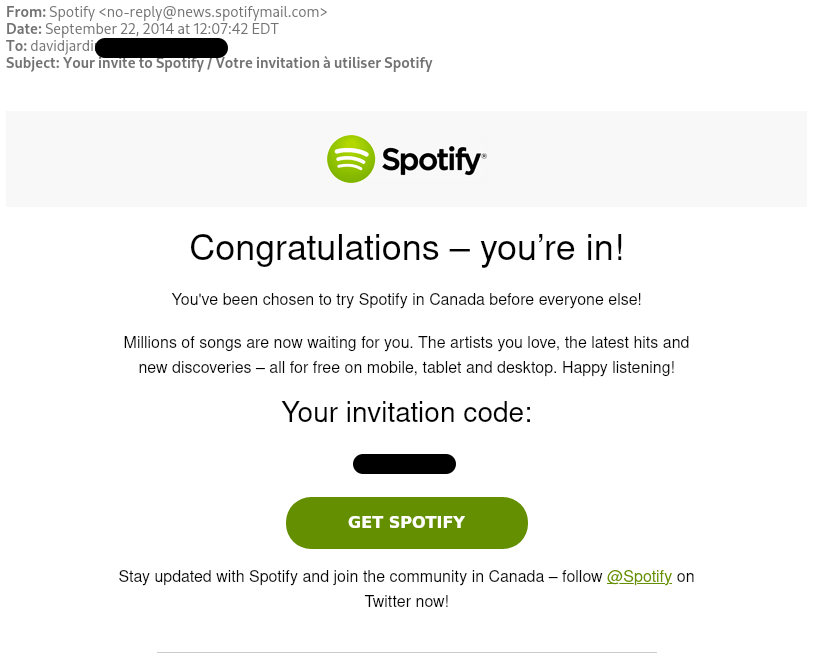
I was one of the first people in canada to get a Spotify account. On September 22, 2014 I got my long awaited email invite with the code to join the new streaming service everyone was excited about. The launch was so highly anticipated you needed to sign up online to get a code sent to you weeks in advance, which is what this email below was for.
Up until this point I was getting my music in all the old-school ways people may be familiar with like finding CDs at the library and downloading them into iTunes or buying songs individually on the iTunes store. I also used limewire once or twice (I was terrified to download a virus on the family computer though so I mainly avoided it) and I used YouTube for poorly edited and slightly off-pitch lyric videos. The only music streaming service I'd ever heard of was Grooveshark (R.I.P.) and it was shut down somewhere around this time.
Spotify sounded like such an amazing service, especialy since the main draw at the time was having a free account and there'd only be a few ads now and then - just like radio stations but an app! As with every tech product though, we've seen it get enshittified until the point where everyone hates it. They don't compensate artists fairly, users are inundated with content we didn't ask for (ads, sponsored podcasts, etc.) and the prices keep going up and up.
Self-Hosting
For these reasons, and a few more (mainly privacy / digital sovereignty), I've been cancelling all of my subscriptions and moving over to self-hosted alternatives. Self-hosting is when you run an open-source application (an app developed for free by a community of developers) on your own servers to have your own private application that you control fully.
There are a few immediate drawbacks to self-hosting when it comes to a content streaming service, like Spotify or Apple Music, but also video streaming like Netflix. The biggest is that you don't get to access their enormous library of content so you need to obtain your own media directly. Personally I'm pretty lucky that I never relied too heavily on Spotify and I still purchased a lot of my most favourite albums to support artists that I like, and before Spotify I had done a pretty good job of frequenting my local library and downloaded a huge amount of music. There's the obvious solution to pirate your music, but this is of course illegal. I certainly won't judge anyone who pirates their music but I recommend not pirating anything put out by a small artist. If you are pirating make sure to look into protecting your internet traffic with a VPN or similar technology - but make sure it is a company that won't be willing to sell your data to an ISP or government because many of them aren't actually in the business of keeping your internet traffic private. There are lots of great online guides and forums to learn about how to pirate and stay safe, but beginning with the r/piracy subreddit is a great start.
Choosing Your Technology
The second big downside to self-hosting your own music streaming is that you have to be your own tech support, and there aren't a ton of options for open-source music streaming applications. I chose to go with AirSonic Advanced (specifically the distro published from linuxserver.io) because while it is an older architecture compared to some newer ones like Navidrome I'd rather take an older and less aesthetically pleasing option over a newer, less time-tested option. It isn't like Navidrome is brand new (it is 5 years old now) and it certainly has a better UI, but I also hate the whole "material design language" that google uses, and navidrome uses it as well. At the end of the day if you want to self-host your music library it needs to be something that works for you so explore the options and pick which will fit your needs. You can check out the Awesome-Selfhosted Github website or the selh.st directory of open-source apps and filter by music streaming to see some options.
If you do choose to go with AirSonic Advanced, I have a Github repo where I've uploaded the docker compose file and Caddyfile that I use to run AirSonic behind a reverse proxy using Tailscale if you want to use that as a starting point (or just copy it directly if you trust my programming and networking). You can find the Github repo here: github.com/davidjardine/Homelab-Setup-Files/tree/main/airsonic.
At the end of the day, you have to weigh the benefits and costs of pursuing a self-hosted solution. I could tell you that it is definitely worth it and that is true - for me. I have a computer science background, I enjoy programming and want to have projects that I can use for job applications and that keep my skills fresh. When it comes to music specifically I wanted to be more actively choosing the music I listen to and not rely on algorithms to discover things. These are the primary reasons that self-hosting my music library makes sense for me, but there are tons of smaller things as well. It is definitely not a good solution for everyone but if you're up for a bit of a challenge and you're tired of the endless rip-off that is subscription services I certainly recommend looking into it.
If money isn't an issue there are lots of server hosting services where you can pay a monthly fee and they take care of the setup and maintenance, PikaPods for example. You lose a lot of the freedom that self-hosting can afford you but again, its all about finding what works best for you. If anything in this post was interesting to you and you want to learn more or talk about it, my email is always open: david@jars.to.
I hope this was interesting, and if it wasn't why did you read all the way to the end? Most of my other posts on here will be less technology focused and be more directly about music, but this was a post I'd been wanting to write on my main blog for a while and after launching this site I figured it was a good one to post here to help get the site started.
Until next time!